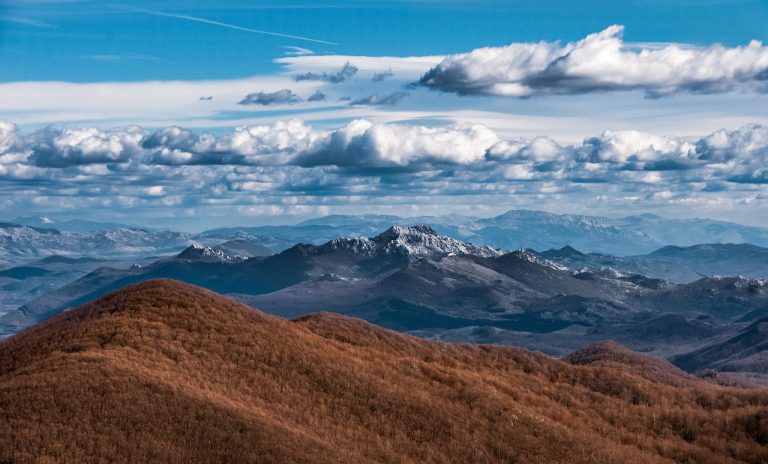
Paklenica National Park
Paklenica National Park includes the canyon of the karst river Paklenica. It is located near Starigrad and Zadar in northern Dalmatia, on the southern slopes of Velebit. It received the status of a national park in 1949, making it our second oldest national park.
The park itself consists of two canyons, Mala and Velika Paklenica. Velika Paklenica canyon is 14 kilometers long and 500 to 800 meters wide. In its narrowest part, the canyon is only 50 m wide. Vertical cliffs rise above both sides of the canyon to a height of over 700 meters. The Mala Paklenica canyon is smaller in size, and the river that flows through it is considerably less powerful. It is 12 kilometers long and 400 to 500 meters wide. In its narrowest part, it is only 10 meters wide, while the surrounding cliffs rise to a height of 650 meters.
The central part of the park is characterized by the relief complex Borovnik and Crni vrh, and nearby are the valleys of Mala and Velika Močila. The eastern part of the Park is geomorphologically very branched, inaccessible and wild. Further to the east, the wilderness zone passes into the area of milder forms around Mali and Veliki Libinj, karst plains with numerous pits, the bottoms of which are mostly cultivated.
The richness of the flora is reflected in the list of over a thousand plant species and subspecies recorded to date, of which 79 are endemic species. Great diversity, the presence of relict, endemic, rare, legally protected species make the park a very valuable floristic area, not only in Croatia, but also in Europe and the world. The diverse habitats in Paklenica and the vertical layering provide a home to a diverse fauna. Invertebrates are relatively poorly researched, but that’s why attractive insects like diurnal butterflies are well researched. More than 40 species of amphibians and reptiles were found, and the endangered Orsini’s viper stands out.
Hiking is the only way to really get to know Paklenica, so the Paklenica National Park covers around 200 kilometers of marked and maintained trails. The trails are intended for tourists and lead them from the Velika Paklenica canyon to the Manita Peća, the Lugarnica grove and the Mountaineering Home, but there are also trails for more serious mountaineers that lead to the highest peaks of Velebit. The paths in the park are marked with boards and hiking signs. The highest area of the Paklenica National Park is the narrow ridge of Velebit, 1 to 3 kilometers wide, and there is also the highest peak of Velebit – Vaganski vrh, 1,757 meters above sea level.
The area of the park is one of the most speleologically explored areas in Croatia. 76 speleological objects (39 pits and 37 caves) are known and explored in the park. The most interesting speleological objects are the Vodarica cave, which is the longest cave (300 meters) on Velebit, and the precipice on Bunovac (534 meters), which is the deepest object in the middle and southern Velebit.
Paklenica National Park is also the most visited climbing area in Croatia and the largest in Southeast Europe. The immediate proximity of the sea water gives this climbing area a special charm, so “Rivijera Paklenica” is an ideal place for a combination of climbing and water sports. Today, there are more than 360 equipped routes of different weights and lengths within the Paklenica climbing areas, so that every climber can find something to his taste. The main climbing season starts in spring and lasts until late autumn.
One of the attractions of the park is the complex of artificial tunnels located near the entrance to Velika Paklenica, and the tunnels were built during the time of Josip Broz Tito during the tense international relations between Yugoslavia and the USSR in the late 1940s and early 1950s.
Depending on the group to which a person belongs and the time of visit, the entrance fee for the park is from 10 to 60 HRK for one day. Considering the size of the park and the necessary hiking, the park management offers multi-day and even annual tickets.